Geography at St Peter’s Brafferton
Intent
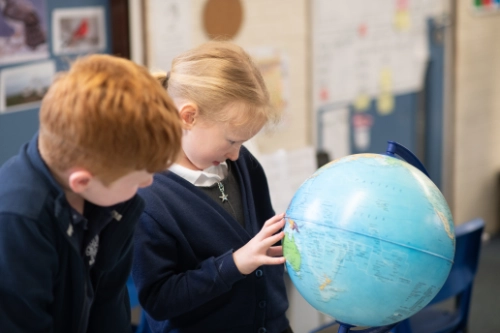
At St Peter’s Brafferton, we inspire pupils curious and explorative thinkers with a diverse knowledge of the world – in other words, to think like geographers. We want pupils to develop the confidence to question and observe places, measure and record necessary data in a variety of ways and analyse and present their findings.
Through our Geography curriculum, we aim to build an awareness of how Geography shapes lives at multiple scales and over time. Geography in our school encourages pupils to become resourceful, active citizens who will have the skills to contribute to and improve the community they live in and the world around them.
Implementation
Our Geography curriculum is progressive and taught in three half term blocks throughout the year, so that children can achieve depth in their learning. Our mixed aged class structure means that Geography is planned and taught over a two year rolling program. This ensures that skills and knowledge are built year by year and sequenced appropriately to maximise learning for all children.
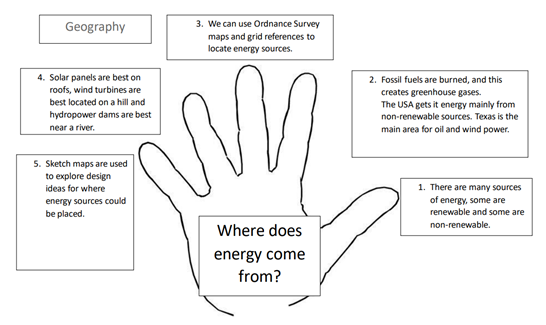
Substantive knowledge is learnt and remembered using our ‘five finger facts’ method. Children are taught five facts each half term that they can learn and recall.
From Y1-Y6, children will have the opportunity to develop their understanding of the following key disciplinary concepts:
- Locational skills
- Place skills
- Human and physical geography skills
- Fieldwork skills
All children including SEND, PP, and children with EAL are supported and challenged at their level enabling them to flourish in line with the school’s commitment to inclusion.
Lessons are designed to be varied, engaging and enquiry based, allowing children to experience the different aspects of an geographical enquiry. This means that over a sequence of lessons, sessions will include the following:
- Posing and answering enquiry questions
- Observing (EG: maps, environments)
- Measuring (EG: simple sampling techniques, designing questionnaires, conducting interviews)
- Recording (EG: taking digital photos, annotating sketches, collecting qualitative data)
- Presenting (EG: Drawing conclusions, presenting findings in different forms)
There are planned opportunities to take part in fieldwork, watch educational videos, discuss fiction and non-fiction texts from around the world and take part in educational visits help bring their learning to life.
We make sure that our curriculum reflects the local context of our pupils, providing opportunities for them to explore and understand the geography of their immediate environment. We also broaden their horizons by engaging with global issues and exploring diverse cultures. We integrate current affairs and real-life examples into our teaching to make the learning relevant and engaging.
The Early Years Foundation Stage (EYFS) follows our own curriculum linked to the ‘Development Matters in the EYFS’ guidance which aims for all children to have an ‘Understanding of the World; by the end of the academic year.
Impact
We want all our children to leave St Peter’s Brafferton as confident geographers. Pupils should leave school equipped with a range of skills to enable them to succeed in their secondary education. Outcomes in books and pupil voice will evidence a broad and balanced geography curriculum and demonstrate children’s acquisition of key skills and knowledge including. Children will meet the relevant Early Learning Goals at the end of EYFS (Reception) and the end of key stage expectations outlined in the National curriculum for History at the end of Key stage 1 and 2.